 ToolTasted
Is VoiceOS Worth It in 2026?
Some links may earn a commission if you subscribe, at no extra cost to you. Commercial relationships do not determine the recommendation; we state the constraints and alternatives.
 Illustration
Is VoiceOS Worth It in 2026?
VoiceOS Pro is worth it if you want your voice to do more than produce text. Its Agent Mode prepares actions across connected apps and waits for your confirmation before acting; Dictation Mode handles standard speech-to-text in 100 languages. Pro costs $11.99/month billed annually ($143.88/year) or $29.99/month — there is no permanent free plan. It runs on Mac and Windows only today. Built by WakoAI Inc., backed by Y Combinator Spring 2025.
VoiceOS is paid from day one. There is no free sign-up option: new accounts choose Pro or Enterprise, per the pricing page (checked October 4, 2026). After any subscription ends, accounts fall to 100 dictation sessions and 25 Agent Mode sessions per week as a fallback floor — that is not a starting offer, it is what remains when paid access stops.
What does VoiceOS actually do?
According to the VoiceOS features page (checked October 2026), the product has three connected modes:
- Dictation Mode — speech becomes polished text in any app, in 100 languages. Filler words are removed, spelling is corrected.
- Edit Mode — select existing text and rewrite it from a spoken instruction.
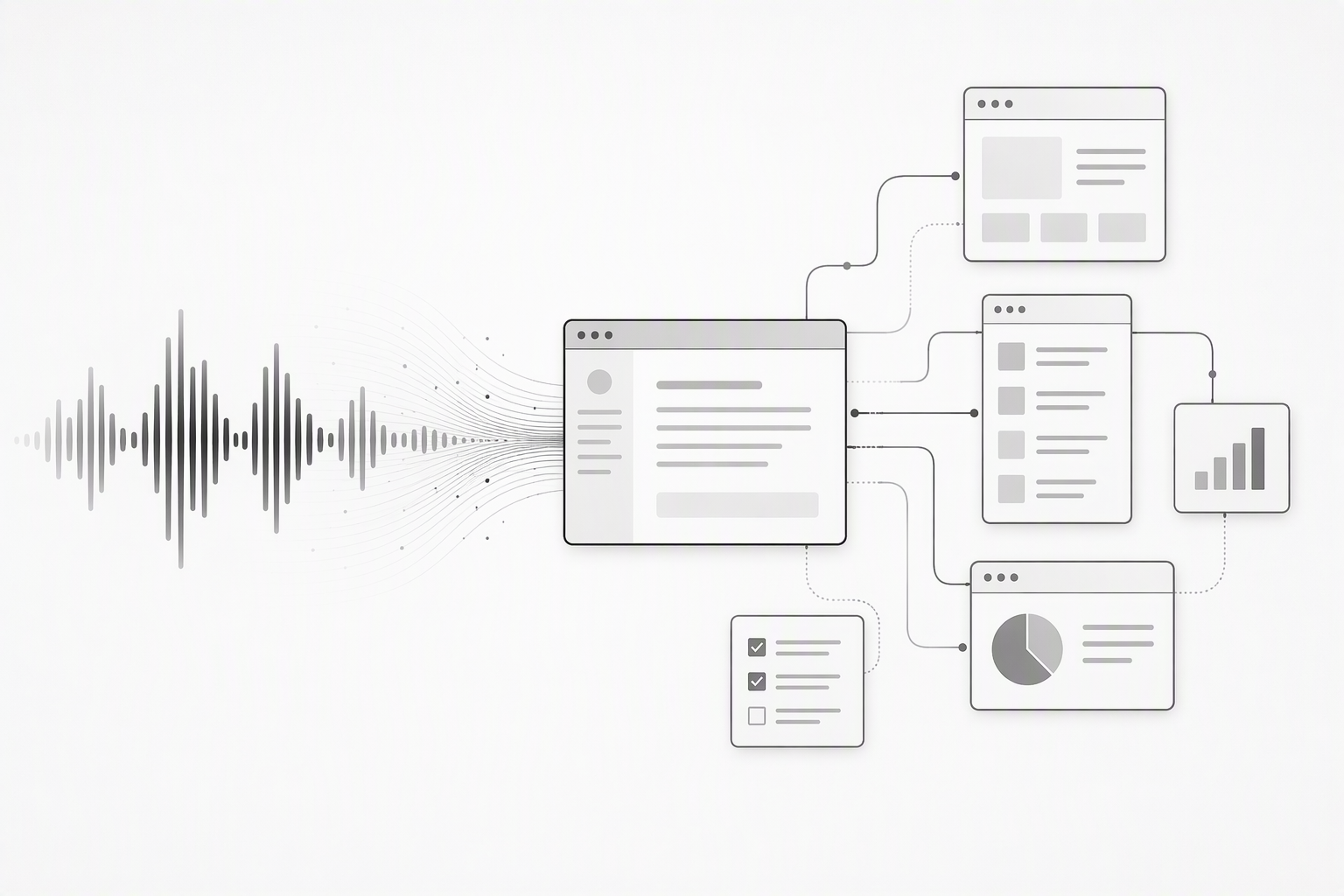
- Agent Mode — VoiceOS reads screen context, answers questions, searches the web with sources, and prepares supported actions across connected apps. Anything that sends, books, or changes something shows a confirmation before completing.
The confirmation step is the design. VoiceOS is not an autonomous agent that acts silently — it drafts, you approve. For a direct comparison of what that means against a dictation-only tool, see the VoiceOS vs Wispr Flow breakdown.
How much does VoiceOS Pro cost?
| Plan | Monthly billing | Annual billing | What is included | |------|----------------|----------------|------------------| | Pro | $29.99/month | $11.99/month ($143.88/year) | Unlimited dictation + Agent Mode, priority support | | Enterprise | Custom | Custom | Everything in Pro, zero data retention, SOC 2 Type II, SSO/SAML |
Prices from voiceos.com/pricing and llms.txt, checked October 4, 2026. Annual billing saves 60% per month versus monthly, per the pricing page. The prices displayed at checkout update to your region automatically — confirm the amount before paying.
Two discounts are available by application: 50% off Pro for enrolled students (enrollment re-verified once a year) and 50% off Pro for builders shipping their own VoiceOS integrations, per the pricing page. Both require a short form reviewed by hand. At the student or builder rate, annual Pro works out to $71.94/year.
Enterprise covers multiple seats, centralized billing, shared team vocabulary and replacements, zero data retention enforced across the organization, SOC 2 Type II certification, and SSO/SAML. Sizing is done by contacting sales.
What platforms does VoiceOS support?
Mac and Windows today. iPhone and Android are listed as "Coming soon" in the pricing comparison (checked October 2026). macOS requires version 10.15 or later and supports both Intel and Apple Silicon, per the llms-full.txt (checked October 2026).
If you need dictation on a phone now, VoiceOS is not ready for that. Wispr Flow lists iOS and Android as current platforms and includes a permanent free tier. The AI voice tools guide for developers maps the current options by platform and use case.
How does Agent Mode work?
Agent Mode connects speech to apps through the VoiceOS App Store integrations and your own MCP servers. The flow is consistent: describe the outcome out loud, VoiceOS reads what is on your screen, assembles a proposed action or answer, and presents it for review. You confirm, edit, or cancel.
The features page (checked October 2026) lists the current capabilities: app integrations, custom MCP server connections, web search with sources, screen awareness, reminders and scheduling, and action confirmation that "varies by action."
The honest way to evaluate it is not reading the App Store catalog. Connect one integration you actually use — a calendar, a messaging app, a task tool — ask VoiceOS to prepare something real, and count the steps remaining after the confirmation prompt. That result is more informative than any feature list.
For developers already routing voice input into automation pipelines, the voice notes to n8n workflow shows a complementary pattern: voice capture feeds structured downstream jobs with explicit boundaries, which is a different problem from what Agent Mode solves.
VoiceOS vs the alternatives
VoiceOS vs Wispr Flow — Flow has a permanent free tier (2,000 words/week desktop), works on iOS and Android now, and is a cleaner dictation tool at $12/month Pro. VoiceOS adds Agent Mode and Edit Mode for cross-app work and has no free tier. Full comparison: VoiceOS vs Wispr Flow.
VoiceOS vs Superwhisper — Superwhisper offers local (offline) transcription models, a one-time $249.99 lifetime license option, and Pro from $8.49/month. VoiceOS is cloud-only and subscription-only but adds Agent Mode that Superwhisper does not have. Offline transcription is not on VoiceOS's roadmap. Full picture: Superwhisper review.
VoiceOS vs macOS built-in dictation — Built-in dictation is free and offline. VoiceOS adds text cleanup, Edit Mode, and Agent Mode. If built-in dictation already handles your tasks, the question is whether those three additions justify $11.99/month.
Who should pay for VoiceOS Pro?
Pay for VoiceOS if:
- You are on Mac or Windows and want voice to initiate cross-app actions, not just produce text.
- You keep switching context to act on what you dictated, and a confirmation-before-action model fits how you work.
- You are a student or eligible builder who qualifies for the 50% discount.
Skip VoiceOS if:
- You need phone dictation now — mobile support is not yet available.
- You only need speech-to-text with no interest in Agent Mode — Wispr Flow's free tier or Superwhisper's local models are lower-cost entries.
- Offline transcription is a requirement — VoiceOS processes in the cloud.
- Your organization requires zero data retention by default — that needs Enterprise at custom pricing.
FAQ
Is VoiceOS free?
No. There is no permanent free sign-up plan. After any paid subscription ends, existing accounts have limited access: 100 dictation sessions and 25 Agent Mode sessions per week, reset every Monday, per the pricing FAQ at voiceos.com/pricing (checked October 2026). That is not a starting plan; it is a fallback after cancellation.
How much does VoiceOS cost?
Pro is $11.99/month billed annually ($143.88/year) or $29.99/month billed monthly, per voiceos.com/pricing and llms.txt (checked October 4, 2026). Annual billing is 60% less per month than monthly. Students and eligible builders can apply for 50% off.
Does VoiceOS act without asking?
No. According to the features page (checked October 2026), anything that sends, books, or changes something shows a confirmation before it is completed. The exact confirmation flow depends on the action and the connected service.
Does VoiceOS work on Windows?
Yes. VoiceOS provides desktop apps for macOS and Windows, per voiceos.com/features (checked October 2026). iPhone and Android are listed as coming soon. The macOS app supports Intel and Apple Silicon on macOS 10.15 or later.
Is VoiceOS secure for sensitive data?
The Pro plan stores transcripts on your device, per the pricing comparison. Enterprise adds zero data retention enforced across the organization and SOC 2 Type II certification. For sensitive workflows, review the VoiceOS security page against your requirements before committing to a plan.
Some links may earn a commission if you subscribe, at no extra cost to you. Commercial relationships do not determine the recommendation; we state the constraints and alternatives.